Rails Monoliths Encode Organizational Assumptions
How Rails monolith architecture reflects team cognition, communication structures, and social contracts in experienced engineering organizations.
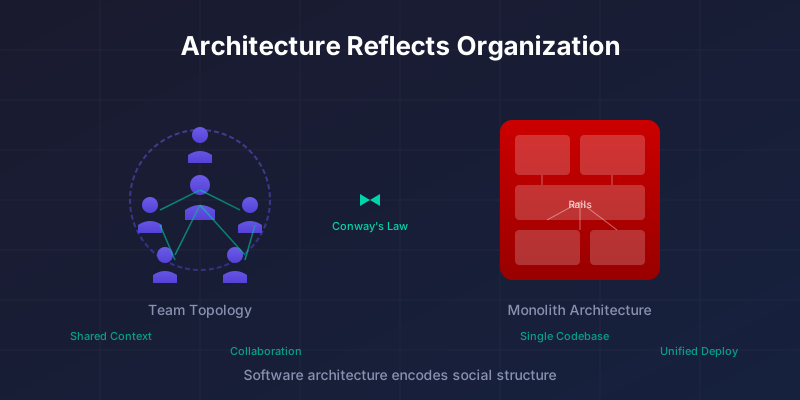
Rails engineers often debate monoliths vs microservices as a purely technical choice - performance, scalability, deployment patterns, containerization, etc. But that’s only half the story. The deeper truth is that software architecture encodes social structure. The codebase isn’t just code; it’s a mirror of how engineers communicate, coordinate, and share knowledge.
In this post, we’ll challenge the simplistic “monolith = bad” narrative. We’ll dig into the organizational assumptions a Rails monolith carries, and why these assumptions matter far more than most engineers realize.
Conway’s Law: The Hidden Organizing Principle
There’s a simple, profound idea at the heart of this discussion: Conway’s Law.
“Organizations which design systems… are constrained to produce designs which are copies of the communication structures of these organizations.”
In plain language: your system’s architecture tends to mirror your team’s communication topology. If teams are siloed, architecture tends to fragment too. If teams are tightly networked, the architecture will reflect that cohesion.
This is not a prescription. It’s an observation of how complex sociotechnical systems evolve.
A Codebase Reflects How Teams Think
A Rails monolith naturally assumes shared context and shared understanding:
- One codebase, one set of conventions, one deployment pipeline.
- Developers read the same files and understand the same domain concepts in the same way.
- Changes touch multiple components, promoting cross-domain visibility.
This structure only works if most engineers have a high degree of shared knowledge. The team has to understand the domain collectively, not in isolated chunks.
A Rails monolith isn’t just convenient - it enforces cognitive alignment. When a concept like Order exists in one place and is used by billing, inventory, shipping, and reporting, teams have to agree on what it means. This is a kind of natural “organizational type checking” that happens at the code level.
That shared cognitive space becomes costly when the team grows big, but it also enforces alignment.
Monoliths Assume High Shared Knowledge
Monoliths don’t scale down the need for communication - they leverage it. The implicit social contract is:
“Before I make a change, I understand, or at least can learn, how this affects other parts of the system.”
That works well when:
- Teams collaborate closely
- Knowledge flow is high
- There’s a culture of code review and shared tooling
Rails plays into this beautifully because it’s opinionated: one framework, one routing system, one ORM. That common ground explicitly signals shared assumptions about how web apps should be built and reasoned about.
But there are limits:
- When teams spin off into sub-domains and stop exchanging context
- When ownership becomes tribal - “I own payments, don’t touch it.”
- When product complexity outgrows shared mental models
These are social failures, not purely technical ones - and the monolith makes them visible.
Microservices Assume Isolated Ownership
Microservices flip the assumptions:
- Each service owns its code, data, and API boundaries
- Teams have autonomy to deploy independently
- Communication happens via explicit contracts (protocols, APIs), not shared logic
That implicitly assumes:
- Teams can operate in isolation
- Each team can own and evolve domain models independently
- Integration costs are managed through APIs, not code structure
This mirrors a team model where information barriers are acceptable and autonomy is a priority.
But that autonomy comes with a price:
- Coupling shifts from code to contracts and communication patterns
- Teams must coordinate changes at the API surface
- Shared domain understanding can drift unless rigorously managed
Which means that while monoliths encode shared understanding, microservices encode isolation and explicit coordination boundaries.
Both architectures reflect an underlying social contract - just a different one.
The Social Contract at the Heart of Architecture
What’s a social contract in this context?
It’s the implicit agreement about how engineers work together:
- How knowledge flows
- What needs consensus vs autonomy
- How responsibility is partitioned
- How communication happens
A Rails monolith assumes:
- Frequent interaction
- Shared context
- Collaborative decision-making
Microservices assume:
- Autonomous teams
- Explicit boundaries
- Contract-driven communication
Neither is strictly “better.” Each is optimized for a different organizational topology. Choosing architecture without this lens is like picking highway signage without knowing the traffic volume.
What Rails Engineers Should Really Think About
Seasoned engineers know that architectural debates aren’t just about code. They are about how humans think and collaborate.
Before debating monoliths vs services, ask your team:
- How fluid is knowledge sharing across the team?
- How do we manage cross-domain understanding?
- Do we want alignment enforced, or autonomy with explicit contracts?
- Are we ready to invest in the coordination infrastructure (APIs, documentation, testing) that microservices demand?
These aren’t technical questions; they are organizational design questions.
Starting from the social contract level reframes architecture as a tool to support how your team actually works - not an abstract technical choice.
When a Monolith Breaks Down
The warning signs are organizational, not technical:
- Knowledge silos: Teams stop reading each other’s code
- Tribal ownership: “Don’t touch my module” becomes the norm
- Review bottlenecks: Nobody understands the full context of changes
- Coordination overhead: Every change requires meetings with multiple teams
When these patterns emerge, the monolith isn’t the problem - it’s revealing a communication breakdown that already exists.
At this point, you have two choices:
- Fix the organization: Restore shared context, improve documentation, rotate team members across domains
- Split the architecture: Accept the silos and formalize them with service boundaries
Option 2 is often chosen because it’s easier than fixing people problems. But if the underlying coordination issues aren’t addressed, you’ll just have the same dysfunction spread across distributed systems - now with network latency and eventual consistency added to the mix.
Conclusion
The real debate isn’t monolith vs microservices. It’s:
What assumptions about knowledge, communication, ownership, and coordination make your team most effective?
- A Rails monolith encodes a contract of shared understanding and collaborative reasoning.
- Microservices encode a contract of isolated ownership and explicit communication.
- Both are reflections of team topology as much as they are technical patterns.
According to Conway’s Law, that reflection is inevitable.
To design better systems, start with organizing the people, not just the code.
Building a Rails application and thinking about architecture decisions? I help teams make these choices based on their actual organizational dynamics, not just technical benchmarks. Get in touch to discuss your situation.
Further Reading
- Team Topologies - Matthew Skelton and Manuel Pais
- Conway’s Law - Original paper
- The Majestic Monolith - DHH on 37signals’ architecture
- Rails 8: Game-Changing Features - More on modern Rails capabilities