TimescaleDB vs PostgreSQL in Rails: When Each Makes Sense
Ruby on Rails vs TimescaleDB: when your app needs time-series over plain PostgreSQL. Covers hypertables, ActiveRecord trade-offs, and performance thresholds.
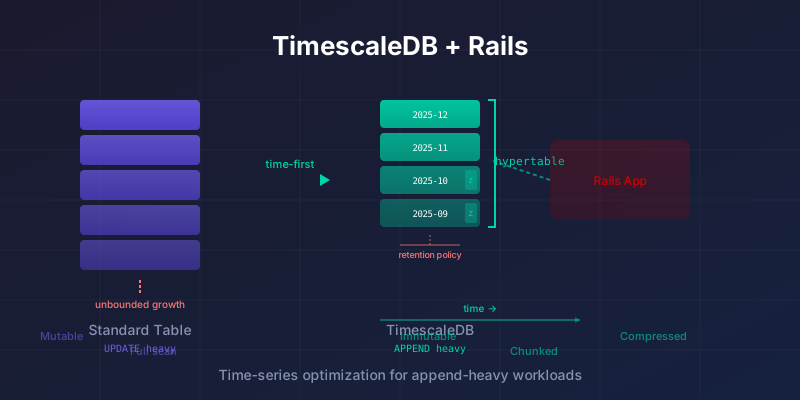
Use TimescaleDB in a Rails app when your data is append-only, time-indexed, grows without bound, and is queried by time range - audit logs, metrics, financial ledgers, IoT events. Stay on plain PostgreSQL for frequently updated rows, core business entities, and anything under a few million rows. TimescaleDB is a PostgreSQL extension, not a separate database.
The rest of this post walks through how that decision plays out in practice, because it is often made for the wrong reasons.
Sometimes it’s performance anxiety. Sometimes it’s scale theater. Sometimes it’s because someone heard “time-series” and assumed it must be the right tool. In practice, TimescaleDB is neither a silver bullet nor an exotic database. It is PostgreSQL with specific opinions about time, retention, and access patterns.
This isn’t a how-to guide. I’m going to walk through when TimescaleDB actually helps in Rails apps, and when it adds complexity without payoff.
TimescaleDB vs Plain PostgreSQL: Quick Comparison
| Plain PostgreSQL | TimescaleDB | |
|---|---|---|
| Best for | CRUD operations, business entities, relational data | Append-only time-series: logs, metrics, IoT events |
| Data pattern | Frequent reads, updates, deletes | Write-heavy, rarely updated, queried by time range |
| Partitioning | Manual (declarative partitioning) | Automatic time-based (hypertables) |
| Retention | Manual cleanup scripts | Built-in retention and compression policies |
| ActiveRecord | Full compatibility | Works, but hypertables restrict UPDATEs and unique constraints |
| Scale threshold | Fine for most tables under 100M rows with proper indexes | Shines above 100M+ time-indexed rows |
| Operational cost | Standard PostgreSQL | Extra extension management, migration complexity |
Rule of thumb: If your data is append-only, time-indexed, and grows predictably, TimescaleDB helps. If your data is frequently updated or relationally queried, stick with PostgreSQL.
What TimescaleDB Actually Is
TimescaleDB is a PostgreSQL extension - not a separate database - that adds hypertables, native retention policies, and compression optimized for append-heavy, time-ordered workloads. You are not adopting a new database paradigm. You are opting into time-first data modeling.
This distinction defines both its power and its limits:
- Hypertables partition data along time (and optionally space)
- Native retention and compression policies run automatically
- Query planner optimizations skip irrelevant time chunks
If your data does not fundamentally care about time, TimescaleDB will not save you.
Where TimescaleDB Excels in Rails Systems
Append-Only, Time-Indexed Data
Use TimescaleDB for append-only, time-indexed workloads: audit logs, financial ledgers, event streams, IoT telemetry. These tables grow without bound, PostgreSQL indexes balloon without partitioning, and query performance degrades unless aggressively managed. TimescaleDB makes time-based chunking automatic and keeps old data compressed and queryable.
Examples in Rails applications:
- Audit logs
- Financial ledgers
- Metrics and events
- Tracking state changes over time
TimescaleDB makes time-based partitioning a default, not a maintenance task.
Retention policies become a declarative concern rather than a manual cron job.
High-Volume Analytical Queries Over Time
Use TimescaleDB for large time-range aggregations. Its chunking lets the query planner skip irrelevant time ranges entirely, making aggregation queries predictable regardless of total table size. Queries that would scan millions of rows in plain PostgreSQL become bounded and fast once the chunk pruning kicks in.
This matters when your Rails app acquires analytical needs:
- “Show me trends over the last year”
- “Compare activity week over week”
- “Aggregate events by hour/day/month”
The performance difference is negligible at 100k rows but enormous at 500 million.
Long-Lived Tables With Predictable Growth
TimescaleDB excels when a table will grow indefinitely - millions of rows per day with no realistic upper bound. Hypertables encode the inevitability of growth into the schema itself, making this architectural honesty rather than optimization.
Use hypertables when you know upfront that a table will grow by:
- Millions of rows per day
- With no realistic upper bound
- With mostly historical access patterns
Where TimescaleDB Is a Bad Fit
Frequently Updated Rows
Keep frequently updated rows in regular PostgreSQL tables. TimescaleDB is optimized for append-heavy workloads, and updating historical rows - statuses, counters, flags - degrades compression, chunk management, and query performance.
If rows change often after creation, a normal PostgreSQL table is the right choice.
Core Business Entities
Never put core domain tables - user accounts, subscriptions, products, invoices - into hypertables. These are not time-series data, even if they have timestamps. Having a created_at column does not make something time-series.
Forcing TimescaleDB onto core domain tables conflates temporal attributes with temporal identity. It is a modeling error that adds complexity without benefit.
Small or Moderately Sized Datasets
Skip TimescaleDB for datasets under a few million rows. Regular PostgreSQL with proper indexes handles this scale without the operational and cognitive overhead TimescaleDB introduces:
- Hypertable management
- Compression policies
- Chunk sizing decisions
- Migration complexity
Premature partitioning is as harmful as premature optimization.
TimescaleDB Trade-Offs in Ruby on Rails
The main Rails trade-off with TimescaleDB is that ActiveRecord does not understand hypertables, retention policies, or chunk boundaries. Schema migrations require more care, some operations cannot be expressed idiomatically, and developers must reason about the database directly - not just Rails.
Specifically, ActiveRecord:
- Does not understand hypertables
- Does not model retention or compression
- Cannot reason about chunk boundaries
This is not a flaw in Rails or TimescaleDB. It is a reminder that advanced data modeling requires explicit thinking.
Teams that adopt TimescaleDB successfully tend to be comfortable dropping below ActiveRecord when needed.
A Common Failure Mode
The most common TimescaleDB mistake is treating it as a general scalability solution instead of a specialized tool for time-series data. Here is a pattern I’ve seen repeatedly:
- A Rails app accumulates large log or event tables
- Queries get slow
- TimescaleDB is introduced globally
- Core domain tables are migrated “for consistency”
- Complexity explodes
TimescaleDB is a specialized tool for data whose primary axis is time. Used selectively, it simplifies systems. Used broadly, it obscures them.
A More Principled Way to Decide
Answer five questions before introducing TimescaleDB into your Rails app. If most answers are “yes,” TimescaleDB is likely a good fit. If not, PostgreSQL will serve you better and more simply.
- Is time the primary dimension of this data?
- Will this table grow without bound?
- Are historical queries more important than point lookups?
- Can rows be treated as immutable after creation?
- Are we willing to reason explicitly about database behavior?
The Bottom Line
TimescaleDB is best understood not as a performance hack, but as a data modeling commitment.
It encodes an assumption: that time is fundamental, not incidental.
Rails systems that embrace that assumption deliberately can scale cleanly for years. Systems that adopt it reflexively often end up more complex than before.
As with most architectural decisions, the hard part is not choosing the tool. It’s being honest about the shape of your data. And as I wrote about in why service objects are not architecture, code organization alone does not solve this - what matters is data ownership, lifecycle, and enforced boundaries.
Need help with database architecture? I help teams with PostgreSQL optimization, schema design, and scaling decisions. If you’re considering TimescaleDB or other database choices, let’s talk. Reach out at nikita.sinenko@gmail.com.
Further Reading
- TimescaleDB Documentation
- Database Optimization Techniques in Rails
- Solid Cache in Rails 8: Database-Backed Caching
- Solid Queue in Rails 8: Setup and Production Config
- Service Objects Are Not an Architecture - Why code organization is not the same as architectural boundaries
- PostgreSQL at Scale